Transnational Asian Identities in Pan-Pacific Cinemas by Philippa Gates Lisa Funnell
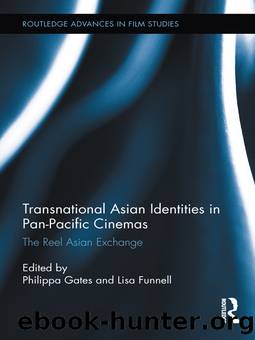
Author:Philippa Gates, Lisa Funnell [Philippa Gates, Lisa Funnell]
Language: eng
Format: epub
ISBN: 9781136591556
Barnesnoble:
Publisher: Taylor & Francis
Published: 2012-03-12T00:00:00+00:00
THE BURDEN OF INTERTWINED HISTORIES
The specters of the past, both distant and close to present, seem to preclude the representation of a harmonious East Asia in contemporary popular culture. Under the umbrella âAsia,â these mega productions pander to a transnational gaze by retreating to the distant or fantastical past in the hopes that regional universality might be achieved in that imagined place. Yet, in reality, it is these intertwined histories that are far from settled. For example, Japanâs refusal to apologize for the atrocities committed during the colonial period, and for the Pacific War, continues to anger Koreans. Japanâs high-ranking politicians make regular visits to the Yasukuni Shrine, which houses the remains of the most notorious war criminals, causing diplomatic frictions (âJapaneseâ ¶8). Furthermore, the publication of a new Japanese History textbook in April 2001, that downplayed colonial and wartime aggression, flamed a nationalist uproar not only in Korea, but also in other parts of Asia (M. Kim ¶13). To further impair Seoul-Tokyo ties, the Japanese sovereign claim over Dokdo/Takeshima, a group of small island, off the east coast of Korea, led to a series of mass demonstrations in Korea. These rocky islands are ânow axiomatic of the nationâs pride,â unveiling the lingering anxiety toward its old master (Dudden ¶8).
Similarly, Koreaâs growing economic and cultural interdependence on China quickly deteriorated with the commencement of a Chinese statefunded research project, the âNortheast Projectâ (2002â6), which charts the peripheral regionâs history and geography (Ahn, âCompetingâ ¶3). The area in question is Chinaâs Northeast province, which borders not only (North) Korea and Mongolia, but also Russia. When the three ancient kingdoms of KoreaâGojoseon, Goguryeo, and Balhaeâwere included in this research, Koreans, who consider themselves as the rightful descendants, were infuriated. The issue here is that Goguryeoâs ambitious general and ruler, Gwanggaeto, conquered vast lands, most of what is now Manchuria. His kingdom Goguryeo, therefore, carries a more symbolic meaning in the twenty-first century as it evokes a distant memory of the large territory that once belonged to Korea. The publicâs reaction against China was heated, to say the least, and, apart from the state-level tensions, ordinary citizens also participated in this history war online as ethnic bashing between the Koreans and Chinese continued (Hong 34â40).
To reiterate, when considering the fact that one of the mainstay themes of epic cinema is a nationâs founding story and its territorial expansion, it is not difficult to fathom what anxieties and pleasures the historical epic may evoke to audiences in respective countries. Yet, such issues are often glossed over in the discussion of transnational co-productions, obscured by the glamour and hype of globalization. From the critical and audience reception of the East Asian blockbusters, I find that the representation of race, the use of language, and casting decisions pose as prominent dilemmas. What language should the film speak? Where should it be set and in what period? And which (national) star should play the role of the hero, or for that matter, the villain? The decision-making process
Download
This site does not store any files on its server. We only index and link to content provided by other sites. Please contact the content providers to delete copyright contents if any and email us, we'll remove relevant links or contents immediately.
| Anthropology | Archaeology |
| Philosophy | Politics & Government |
| Social Sciences | Sociology |
| Women's Studies |
Cecilia; Or, Memoirs of an Heiress — Volume 1 by Fanny Burney(32636)
The Great Music City by Andrea Baker(32609)
Cecilia; Or, Memoirs of an Heiress — Volume 2 by Fanny Burney(32010)
Cecilia; Or, Memoirs of an Heiress — Volume 3 by Fanny Burney(31996)
We're Going to Need More Wine by Gabrielle Union(19108)
All the Missing Girls by Megan Miranda(16314)
Pimp by Iceberg Slim(14664)
For the Love of Europe by Rick Steves(14566)
Bombshells: Glamour Girls of a Lifetime by Sullivan Steve(14136)
Norse Mythology by Gaiman Neil(13457)
Talking to Strangers by Malcolm Gladwell(13439)
Fifty Shades Freed by E L James(13289)
Mindhunter: Inside the FBI's Elite Serial Crime Unit by John E. Douglas & Mark Olshaker(9420)
Crazy Rich Asians by Kevin Kwan(9345)
The Lost Art of Listening by Michael P. Nichols(7547)
Enlightenment Now: The Case for Reason, Science, Humanism, and Progress by Steven Pinker(7354)
The Four Agreements by Don Miguel Ruiz(6835)
Bad Blood by John Carreyrou(6669)
Weapons of Math Destruction by Cathy O'Neil(6362)
